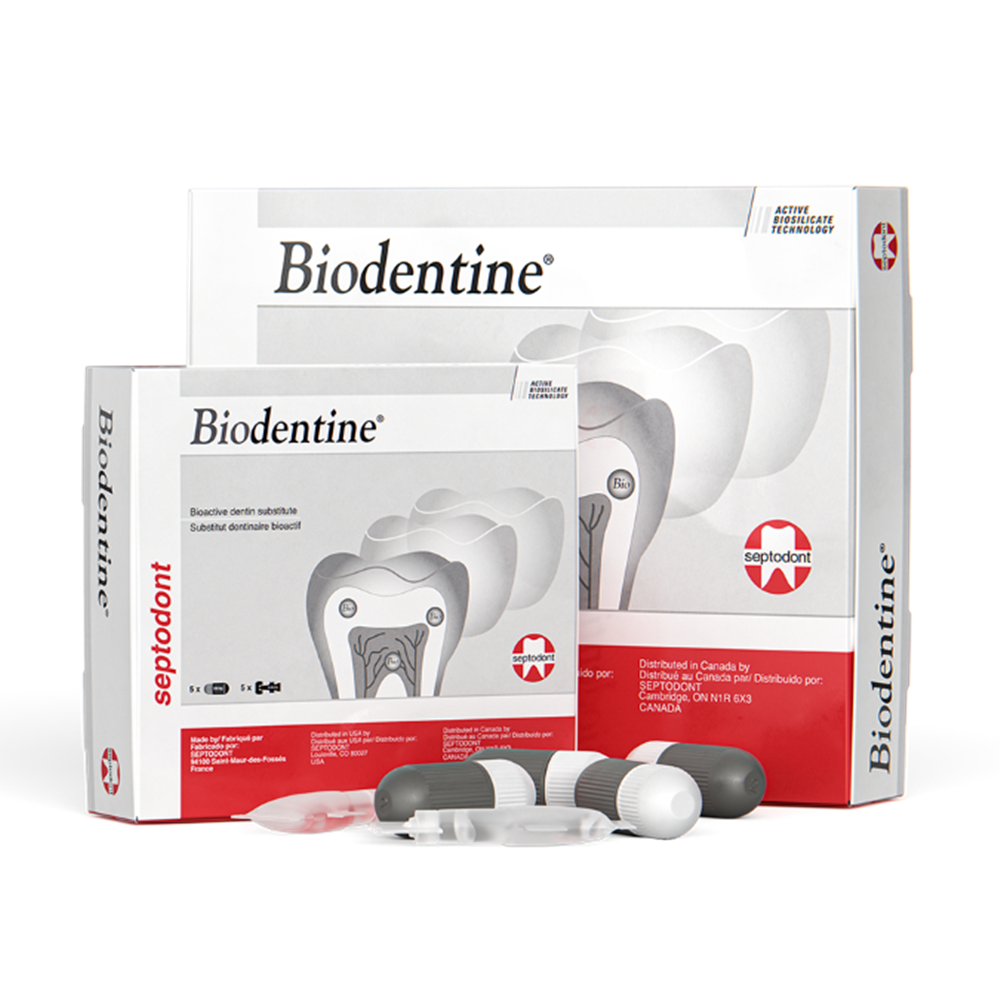
 When it was launched in 2009, Biodentine™ became the first all-in-one dentine substitute capable of fully restoring lost dentine and enamel tissue in both the root and crown. Based on patented Active Biosilicate Technology™, the ultra-pure tricalcium silicate cement shows proven bioactivity, biocompatibility, mechanical strength, and dimensional stability1,2. Thanks to these qualities, Biodentine™ has demonstrated consistent success in restorative and endodontic procedures.
Dr Kreena Patel, Specialist in Endodontics, can attest to this. Having used Biodentine™ in these restorative procedures for more than a decade, she previously used only a thin layer under glass ionomer cement (GIC) and a composite restoration. However, since discovering the benefits of Biodentine™ as a bulk-filling material three years ago, she no longer uses GIC. Instead, she now places Biodentine™ from pulp to crown with the Bio-Bulk Fill procedure, placing the permanent composite restoration directly on top.
As Dr Patel explains in more detail here , this offers a number of practical benefits for both herself and her patients. Notably, the Bio-Bulk Fill procedure with Biodentine™ can be completed quickly in a single session, meaning less chair time and fewer appointments. But most importantly, Biodentine™ allows her to elevate her patients’ clinical results and long-term outcomes. Here’s why.
More teeth saved with superior bioactivity3-6 **
Preserving the vitality of the tooth is always preferable where possible. As Dr Patel notes: “The pulp performs a plethora of important functions, including dentinogenesis, immune cell defence and proprioception.” Preserving the pulp tissue maintains these essential functions and is the least invasive treatment.
With its superior bioactivity3-6**, Biodentine™ is opening up this possibility for more and more patients. It works with the patient’s own innate healing capabilities to restore pulp health by promoting a favourable environment for angiogenesis and growth factor release.2 It also creates pores in the underlying dentine through which high concentrations of calcium, hydroxyl and carbonate ions diffuse, increasing mineral deposition and creating reactionary dentine and dentine bridges.3-5
Research on these bioactive properties supports Dr Patel’s decision to switch from GIC to bio-bulk filling with Biodentine™. The dentine layer created by Biodentine™ is found to be thicker and denser than that created by GIC, providing optimal pulp protection.1 This holds true against other materials; significantly more tertiary dentine is observed when Biodentine™ is used compared to MTA or calcium hydroxide, and Biodentine™ produces a more porous dentine bridge than the latter.7
Excellent biocompatibility with the pulp tissue1,8***
Many tricalcium silicate materials are based on Portland cement, which contains only 68% tricalcium silicate and is noted to contain residual toxic trace elements from the manufacturing process.9
Biodentine™, however, uses tricalcium silicate made with patented Active Biosilicate Technology™. Septodont maintains tight control of the entire manufacturing process from start to finish, ensuring the elimination of aluminium, trace metals and other impurities.1 The result is a material of unrivalled purity with no cytotoxic, mutagenic, sensitising, or irritant effects on the pulp (even when exposed), ensuring high cell viability and enhancing biological healing.1,2
Antimicrobial properties for successful treatment outcomes
The persistence of bacteria is one of the primary reasons for endodontic or restorative treatment failure, leading to complications like infection, secondary caries and pain. Biodentine™ produces hydroxyl ions during the setting phase, creating a very alkaline pH of 11+ that is highly unfavourable for bacterial growth.2,10 This can greatly reduce the risk of complications and avoid the need for retreatment.
In indirect pulp capping procedures, when a thin layer of carious dentine may be left in place over the pulp, leaving behind a certain number of bacteria is unavoidable. With its antimicrobial properties, Biodentine™ helps practitioners to manage this risk and offer a more conservative treatment approach, where more of the natural tooth vitality and functionality is preserved.11
The strength and hardness of natural dentine
A significant factor that influenced Dr Patel’s decision to switch from GIC to Biodentine™ in Bio-Bulk Fill is the latter material’s strength. She says: “We know that Biodentine™ has very similar physiomechanical properties to natural dentine, so it lends itself very well to this use.”
Both Biodentine™ and GIC have a similar flexural strength to natural dentine; the core difference lies in the compressive strength and hardness. Both materials show a sharp increase in compressive strength in the 60 minutes after setting. However, after 24 hours, Biodentine™ begins to rapidly outpace GIC and approaches natural dentine in both compressive strength and microhardness.1 At seven days, the compressive strength of GIC starts to decline, while that of Biodentine™ continues to improve, reaching a final strength comparable to natural dentine at 28 days.
For the patient, this offers a stable, durable restoration which is less vulnerable to fracture from normal chewing forces and replicates the functional strength of their natural tooth, with high long-term clinical and radiographic success rates.12
Complete confidence in the seal
Dr Patel notes that the success of pulp capping procedures, pulpotomies and perforation repairs ultimately depends on a reliably tight marginal seal. Biodentine™ helps her to achieve this for her patients in several ways.
First, Biodentine™ demonstrates exceptional adhesion to the dentine wall via micro-mechanical anchorage.1 The material deposits mineral tags into the openings of the dentine tubules, creating a tight interface and a strong bond with the dentine surface13. This is achieved without the need for dentine conditioning, reducing the risk of post-operative sensitivity for the patient.13 Further, the bond continues to strengthen after setting.
Second, Biodentine™ has a resin-free formula with very low water content and porosity compared to similar materials. As a result, it maintains excellent dimensional stability over time, with high resistance to shrinkage and microleakage.15,16 Biodentine™ can undergo slight acid erosion in highly acidic solutions, but shows greater acid resistance and significantly less microleakage than GIC under the same conditions.1
When placing Biodentine™ under a composite restoration, Dr Patel notes that some practitioners worry that Biodentine™ will be pulled away from the pulp when the composite polymerises and shrinks, leaving behind a space. Although she shared these concerns in the past, Dr Patel has since discovered that a thicker layer of Biodentine™ provides ample insurance against the risks posed by composite shrinkage.
An ally in even the most challenging cases
For Dr Patel, choosing Biodentine™ allows her to offer excellent outcomes for patients in even the most complex cases.
She recalls one patient who presented with signs of reversible pulpitis three weeks after pulp exposure during caries removal by his general dentist.17 Radiographic imaging revealed a surprising eight root canals, leading to the discovery of a rare developmental anomaly called gemination. This occurs when two tooth buds attempt to divide, leading to separate crowns and a common canal system.
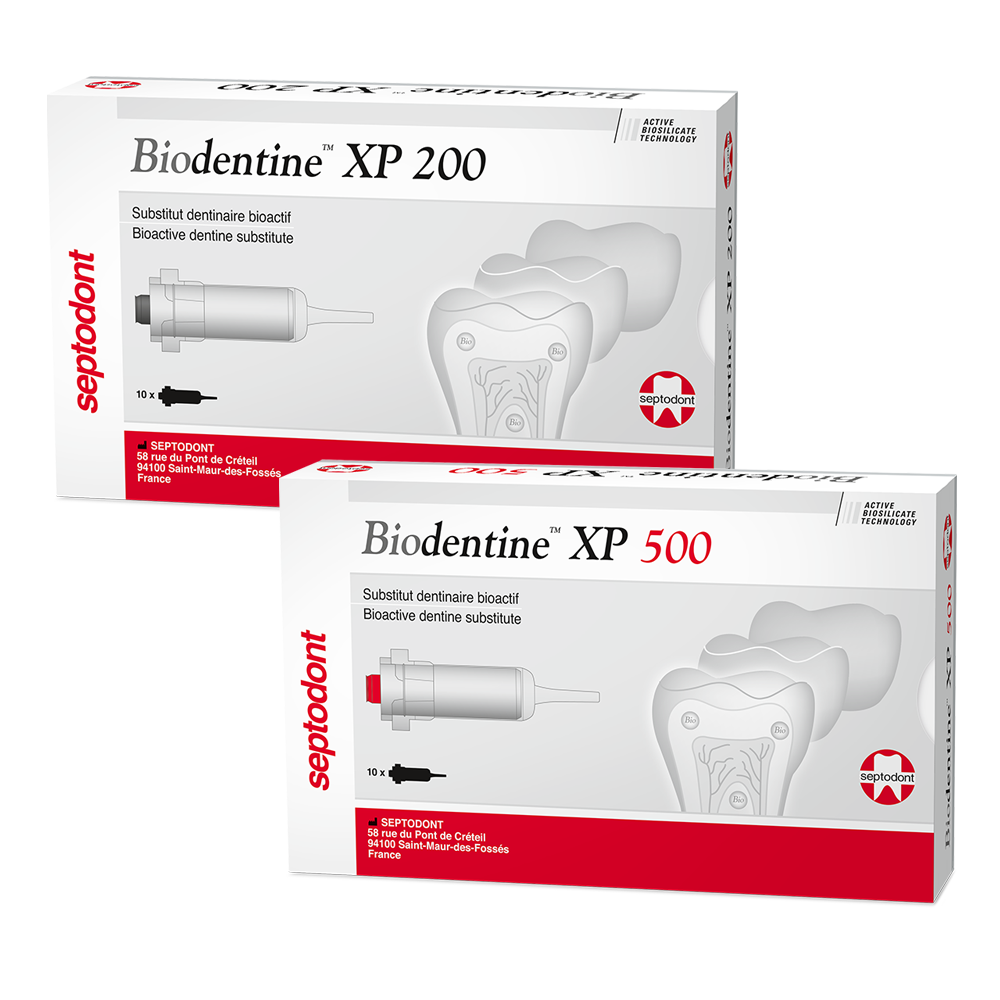
By this stage, Dr Patel anticipated irreversible inflammation around the exposure site, but she knew that endodontic treatment in such a complex root anatomy would have required a larger, more destructive access cavity with a challenging restoration. She therefore opted for vital pulp therapy with Biodentine™ XP in the Bio-Bulk Fill procedure instead.
Dr Patel chose a partial pulpotomy over a full pulpotomy in order to preserve more coronal tooth structure and pulp tissue. After removing 2-3mm of pulp, she was able to place Biodentine™ XP directly over the exposure site and place the composite restoration in the same visit. Although the patient’s sensitivity persisted for two weeks following the procedure, he was asymptomatic at the seven-month follow-up, and radiographic images showed no periapical radiolucency and almost no pulpal retraction.
Selling patients on the benefits of BiodentineTM
We know the value of BiodentineTM as dental professionals, but how do we convince the patient? Dr Patel says:
“As a clinician, you do need to build the cost of BiodentineTM into your fee, otherwise you’ll be hesitant to use the material. So I do charge an extra fee to use it, and that accounts for the time it’s going to take as well. But it’s important to justify this in terms that matter to your patient.
I explain to my patients that I feel BiodentineTM offers the best chance for the pulp to survive. Quite often these days, our patients are more educated about dental health. They understand the need to preserve the tooth for good long-term outcomes and they’re usually keen to be more conservative with their treatment. I explain how BiodentineTM can help them to achieve that, and their response is typically very positive.”
She concludes:
“Ultimately, patient satisfaction comes down to two things: the patient is not in pain after their treatment and they get good long-term results. In my experience, when I’m working in close proximity to the pulp, Biodentine™ is the best material for that.”
References
1. Internal data: Biodentine™ Scientific File. 2011.
2. About I, ed. Biodentine™ Properties and Clinical Applications. Switzerland: Springer. 2022.
3. Elbanna A, Atta D, Sherief DI. In vitro bioactivity of newly introduced dual-cured resin-modified calcium silicate cement. Dent Res J (Isfahan). 2022 Jan 28;19:1. doi: 10.4103/1735-3327.336686. Available at: https://pubmed.ncbi.nlm.nih.gov/35308449/
4. Nowicka A, Wilk G, Lipski M, Kołecki J, Buczkowska-Radlińska J. Tomographic Evaluation of Reparative Dentin Formation after Direct Pulp Capping with Ca(OH)2, MTA, Biodentine, and Dentin Bonding System in Human Teeth. J Endod. 2015 Aug;41(8):1234-40. doi: 10.1016/j.joen.2015.03.017. Available at: https://pubmed.ncbi.nlm.nih.gov/26031301/
5. Gong V, França R. Nanoscale chemical surface characterization of four different types of dental pulp-capping materials. J Dent. 2017 Mar;58:11-18. doi: 10.1016/j.jdent.2016.12.009. Available at: https://pubmed.ncbi.nlm.nih.gov/28043847/
6. Bakhtiar H, Nekoofar MH, Aminishakib P, Abedi F, Naghi Moosavi F, Esnaashari E, Azizi A, Esmailian S, Ellini MR, Mesgarzadeh V, Sezavar M, About I. Human Pulp Responses to Partial Pulpotomy Treatment with TheraCal as Compared with Biodentine and ProRoot MTA: A Clinical Trial. J Endod. 2017 Nov;43(11):1786-1791. doi: 10.1016/j.joen.2017.06.025. Available at : https://pubmed.ncbi.nlm.nih.gov/28822566/
7. Chauhan A, Dua P, Saini S, Mangla R, Butail A, Ahluwalia S. In vivo Outcomes of Indirect Pulp Treatment in Primary Posterior Teeth: 6 Months' Follow-up. Contemp Clin Dent. 2018 Jun;9(Suppl 1):S69-S73. doi: 10.4103/ccd.ccd_48_18. https://pmc.ncbi.nlm.nih.gov/articles/PMC6006903/
8. Poggio C, Ceci M, Dagna A, Beltrami R, Colombo M, Chiesa M. In vitro cytotoxicity evaluation of different pulp capping materials: a comparative study. Arh Hig Rada Toksikol. 2015 Sep 1;66(3):181-8. doi: 10.1515/aiht-2015-66-2589. Available at: https://pubmed.ncbi.nlm.nih.gov/26444338/
9. Camilleri J. Characterization and hydration kinetics of tricalcium silicate cement for use as a dental biomaterial. Dent Mater. 2011 Aug;27(8):836-44. doi: 10.1016/j.dental.2011.04.010. Available at: https://pubmed.ncbi.nlm.nih.gov/21600643/
10. Kaur M, Singh H, Dhillon JS, Batra M, Saini M. MTA versus Biodentine: Review of Literature with a Comparative Analysis. J Clin Diagn Res. 2017 Aug;11(8):ZG01-ZG05. doi: 10.7860/JCDR/2017/25840.10374. Available at: https://pubmed.ncbi.nlm.nih.gov/28969295/
11. Boddeda KR, Rani CR, V Vanga NR, Chandrabhatla SK. Comparative evaluation of biodentine, 2% chlorhexidine with RMGIC and calcium hydroxide as indirect pulp capping materials in primary molars: An in vivo study. Journal of the Indian Society of Pedodontics and Preventive Dentistry. 2019 Jan-Mar;37(1):60-66. DOI: 10.4103/jisppd.jisppd_213_17. Available at: https://europepmc.org/article/med/30804309
12. Bastos MC, Albuquerque FGA, Filho ELC, Silva PGB, Rolim JPML. Clinical and radiographic success of pulpotomy and pulpectomy in primary and permanent teeth: a Systematic Review and Meta-Analysis. J Clin Exp Dent. 2024 Sep 1;16(9):e1120-e1128. doi: 10.4317/jced.61346. https://pmc.ncbi.nlm.nih.gov/articles/PMC11470449/
13. Atmeh AR, Chong EZ, Richard G, Festy F, Watson TF. Dentin-cement interfacial interaction: calcium silicates and polyalkenoates. J Dent Res. 2012 May;91(5):454-9. doi: 10.1177/0022034512443068. Available at: https://pmc.ncbi.nlm.nih.gov/articles/PMC4077527/
14. Kaul S, Kumar A, Jasrotia A, Gorkha K, Kumari S, Jeri SY. Comparative Analysis of Biodentine, Calcium Hydroxide, and 2% Chlorhexidine with Resin-modified Glass Ionomer Cement as Indirect Pulp Capping Materials in Young Permanent Molars. J Contemp Dent Pract. 2021 May 1;22(5):511-516. Available at: https://pubmed.ncbi.nlm.nih.gov/34318769/
15. Niranjan B, Shashikiran ND, Singla S, Thakur R, Dubey A, Maran S. A comparative microleakage evaluation of three different base materials in Class I cavity in deciduous molars in sandwich technique using dye penetration and dentin surface interface by scanning electron microscope. J Indian Soc Pedod Prev Dent. 2016 Oct-Dec;34(4):324-30. doi: 10.4103/0970-4388.191410. Available at: https://pubmed.ncbi.nlm.nih.gov/27681395/
16. Abdelmegid FY, Salama FS, Al-Mutairi WM, Al-Mutairi SK, Baghazal SO. Effect of different intermediary bases on microleakage of a restorative material in Class II box cavities of primary teeth. Int J Artif Organs. 2017 Mar 16;40(2):82-87. doi: 10.5301/ijao.5000566. Available at: https://pubmed.ncbi.nlm.nih.gov/28222209/
17. Septodont USA. Pulpotomy on an 8-canal tooth? Case Study by Dr. Kreena Patel. 2024. Available at: https://www.septodontusa.com/media-content/freemium-biodentine-xp-expert-pulpotomy-on-an-8-canal-tooth-case-study-by-dr-kreena-patel/
** Highest mean value of Calcium release and its superior concentration that encourages positive interaction with pulp cells.
*** Biodentine™ showed the highest % of cell biocompatibility.
Properties verified by preclinical studies.